 English
 Español
 عربي
 Pусский
 Oct 22, 2026
Visit:3
Oct 22, 2026
Visit:3
A long-run flexo job rarely loses register all at once. It walks. The first 5,000 sheets look clean, the 20,000th is still within tolerance, and somewhere past 50,000 the operator notices that the black is sitting a half-line off the cyan—and it keeps getting worse. By the time the drift is visible to the naked eye, it has been accumulating for hours.
That is what makes register drift on long runs different from a sudden misregistration. Sudden misregistration announces itself: a splice shock, a plate lift, a sensor that lost the mark. Drift is silent. It is the sum of small, slow changes—thermal growth, tension creep, sensor degradation, mechanical wear—each individually too small to trigger an alarm, but additive across the run. Fixing it means treating it as a time-dependent problem, not a one-time adjustment.
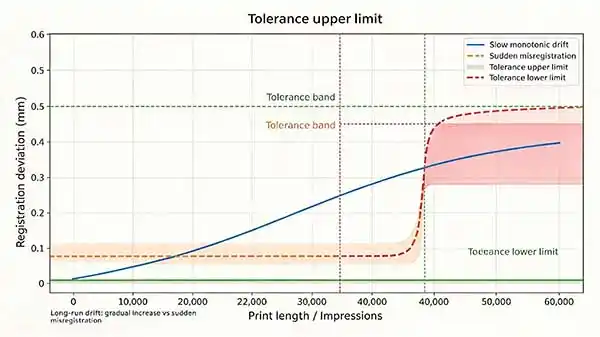
Register drift is the gradual movement of register marks away from their target position over the duration of a print run. Unlike a step change—where register shifts abruptly and stays shifted—drift is progressive. The register error at 10,000 impressions is measurably larger than at 2,000; the error at 40,000 is larger still. In practical terms, the job may start well inside tolerance and finish outside it without any single obvious fault having occurred.
This temporal signature is diagnostically important. A drift that grows monotonically with run length points toward a state variable that is itself changing monotonically—temperature, roll diameter, sensor lens contamination, or the accumulated effect of gear backlash under sustained load. A drift that oscillates or steps points elsewhere: dancer sensitivity, splice disturbances, or a discrete mechanical event.
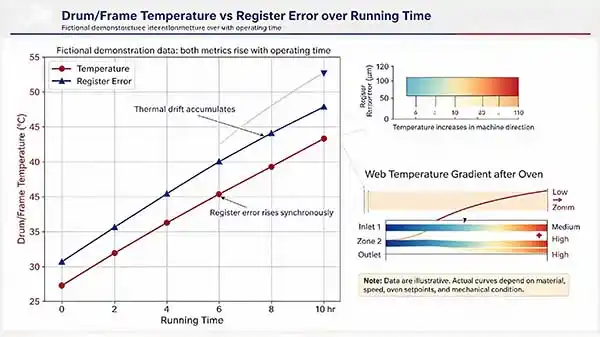
The central impression cylinder on a CI press grows as it warms. During a high-speed extended run, the drum heats up and its diameter increases slightly, changing the effective print circumference. On a long repeat job, this expansion throws off register between the first and last color stations, producing circumferential drift that increases over run time. The press frame is not immune either: temperature changes can expand the steel frame and alter the distance between decks, introducing a second thermal error path. Thermal drift is typically the dominant contributor on jobs that run for hours without a cold-start baseline.
Web tension does not stay where it is set. As the unwind roll diameter shrinks and the rewind builds, the tension dynamics in each zone change. A dancer roller set too insensitive fails to absorb speed variations, and tension spikes travel into the print zone; set too sensitive, it over-corrects and introduces rhythmic oscillation. Either way, the substrate stretches or contracts between stations, and the cumulative effect over tens of thousands of impressions is a register that walks in one direction—most visibly after accelerations or splices that the tension loop does not fully absorb.
Mechanical contributions to drift are small per revolution but accumulate over a long run. Gear backlash in a geared press—the microscopic gap between meshing teeth—causes teeth to shift slightly under high speed or variable tension, producing micro-registration drift that manifests as ghosting or inconsistent trapping over time. Bearing seats, couplings, and deck locks can also relax marginally under sustained vibration. These are not failures; they are the slow accommodation of a mechanical system under load, and they show up as drift precisely because a long run gives them enough cycles to add up.
A dirty register mark or sensor does not usually fail cleanly. It misreads. When the optical head or the printed mark is partially obscured by ink mist, paper dust, or dried residue, the detected mark position can bias slightly, and the automatic register control chases that biased error. The result is a register that walks—the control system is doing its job, but it is doing it on bad position data. On long runs, contamination is progressive, so the bias grows with time.
Scheduled register-trend sampling. Pull a sample at fixed intervals—every 10,000 or 20,000 impressions—and measure the actual register error against the target on a register cross or a printed control strip. Plot error against run length. A monotonic upward or downward slope identifies drift; a step change identifies an event. This is the single most diagnostic record a long-run job can produce, because it separates time-dependent causes from discrete ones.
Automatic threshold alarming. Modern register control systems can log register error continuously and alarm when the error exceeds a defined window. The value is not just the alarm itself but the slope of the error over time. A system that alarms at 0.15 mm after 40,000 impressions is telling a different story than one that alarms at the same error after 5,000—the former is drift, the latter is likely a setup or mechanical issue.
Thermal baseline checks. Record drum or frame temperature at start-up and at intervals through the run alongside register error. If circumferential register error tracks drum temperature, thermal expansion is confirmed as a primary driver. Many high-end presses have chilled-water circulation or cooling channels specifically to hold this variable steady; confirming whether those systems are performing is part of drift diagnosis.
Stabilize the thermal environment before chasing register. Verify that dryer temperatures are stable across the run and that there is no localized overheating of one deck or one side of the drum. If the press has drum cooling, confirm that supply temperature and flow are within specification. Engage cooling and allow the press to reach thermal equilibrium before trimming register—adjusting register on a cold press only to watch it drift as the press warms is a self-defeating cycle.
Calibrate the tension loop zone by zone. Do not assume that a tension setpoint displayed on the HMI reflects actual web tension. Check dancer response and load-cell feedback in each zone, and verify that brake and drive systems are not hunting. Closed-loop tension control with load cells and dancer rollers is the baseline; the corrective step is confirming that the closed loop is actually closing on the correct signal. On jobs that run through multiple roll changes, pay particular attention to whether tension recovers fully after each splice—a slow recovery that never quite returns to setpoint is a drift generator.
Clean the optical path, not just the lens. Clean the CCD camera lens and the register mark area, but also check for ink mist accumulation on protective covers, air-purge ports, and the mark itself. A mark that reads with reduced contrast is a mark that will eventually misread. Establish a cleaning cadence tied to run length rather than shift time—on a long run, the relevant interval is impressions, not hours.
Fasten what has loosened. If drift persists after thermal and tension variables are controlled, inspect bearing seats, coupling hardware, and deck locking mechanisms. Gear backlash cannot be eliminated on a geared press, but loose hardware amplifies its register consequences. On gearless presses, verify that servo feedback is clean: encoder condition and drive tuning matter more than mechanical fasteners, because the “mechanical” error path has been replaced by an electronic one.
Build a thermal warm-up and re-register discipline into the job. Run the press at production speed until drum and frame temperatures stabilize, then trim register. Treat the first register trim as a warm-up trim, not a production trim. A documented warm-up sequence followed by a re-register step prevents the predictable early-run drift that comes from trimming on a cold machine.
Preset register compensation by substrate. Paper substrates respond to tension and temperature differently, and the coefficient of thermal expansion varies by grade and moisture content. Where the press control system supports compensation curves or substrate-specific presets, build them from observed drift data on previous jobs rather than from generic defaults. A compensation curve derived from a paper job's actual register-versus-run-length behavior is more useful than a theoretical coefficient, because it captures the combined effect of thermal growth, tension response, and mechanical accommodation on that specific press and substrate.
Schedule mid-run inspection at an impressions-based interval. Set a register check at a fixed number of impressions—20,000 is a practical starting point—and treat it as a mandatory gate rather than a discretionary check. The purpose is to catch drift while the error is still small and correctable, before it becomes visible waste. Record the error at each check so that the next long run starts with a drift trend for that job, not a blank slate.
For operations that run long jobs as a routine part of the order book, automatic register control with trend logging and substrate-aware compensation is the structural answer to drift. An automatic register system that reads marks continuously and adjusts deck timing on the fly can correct slow thermal drift without operator intervention, provided the mark signal is clean and the control loop is not being fed a biased reading by a contaminated sensor. Pairing that capability with a disciplined warm-up and impressions-based inspection interval converts register drift from a chronic waste source into a monitored, bounded variable.
Both architectures drift, but the mechanism differs. On a geared press, backlash in the gear train allows teeth to shift under high speed or variable tension, producing micro-registration drift that accumulates across print stations and over run time. Gearless presses eliminate that backlash path: each deck is driven by an independent servo motor, and registration stability is maintained through electronic synchronization rather than steel mesh. In practice, gearless systems hold registration accuracy in the range of ±0.05 mm, compared with ±0.15–0.3 mm on geared systems, and the absence of gear wear removes a progressive drift mechanism that worsens as the gear train ages. A geared press can run long jobs successfully, but it requires more attention to backlash management and mechanical wear as drift contributors.
Look at the register error versus run length. Drift is progressive: the error at 30,000 impressions is measurably larger than at 5,000, and the plot has a slope. Sudden misregistration is a step: the error is stable, then jumps, then stays at the new level until corrected. The diagnostic distinction matters because the causes are different. Drift points toward thermal growth, tension creep, sensor contamination, or wear. A step points toward a splice shock, a plate lift, a sensor that lost the mark entirely, or a discrete mechanical event. Sampling at intervals and plotting error against run length takes only a few data points to make the distinction visible.
Yes, within limits. Automatic register control systems can track slow thermal drift and adjust deck timing or circumferential position continuously, and temperature feedback can be incorporated into the register control logic so that the system anticipates expansion rather than merely reacting to its register consequence. Compensation curves and substrate-specific presets extend this by encoding the observed relationship between run time, temperature, and register error for a given material. What software cannot do is compensate for a thermal problem that is uncontrolled at the source—a failing chiller, a dryer running hot on one side, or a drum cooling circuit that is blocked. Software compensation manages the residual after the thermal environment is stabilized; it does not replace thermal stability itself.
contact our flexo engineers with your register trend data and substrate details.
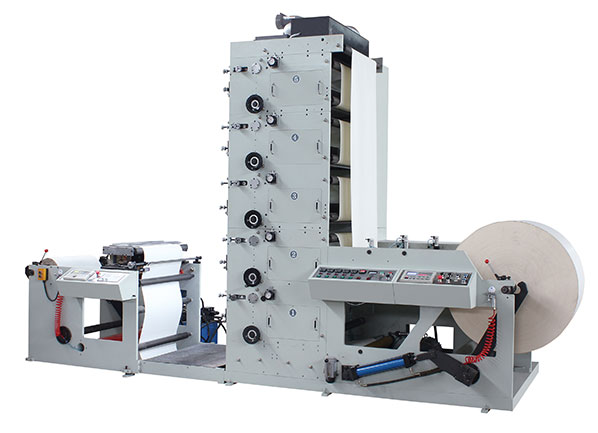
FLEXO PRINTING MACHINE
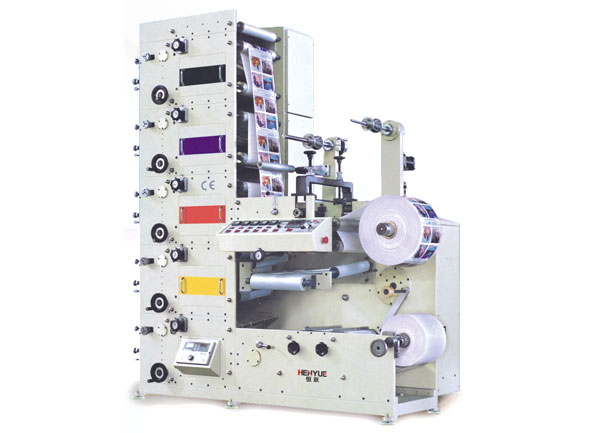
FLEXO PRINTING MACHINE
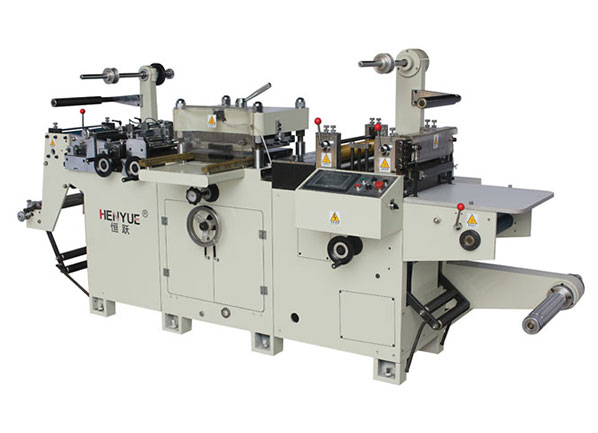
FLEXO PRINTING MACHINE
GET A QUOTE